
Organizer: BDU.
About the Course
- Free Online SQL Relational Database with Certificate
- Certificate: Certificate Offered
- Estimated Effort: 5 Hours
- Level: Beginner
- Skills You Will Learn: Databases, SQL
- Language: English.
- Perfect For: Students, Freshers, Working Professionals, Career Switchers
- Free Online Learning
- Industry-Recognized Digital Credentials
- Self-Paced Courses
- Learn from IBM Experts
- Boost Your Resume & LinkedIn Profile.
Apply Link
100% Correct Answers SQL Relational Database Course Available Here
Modules 1. SQL relational Dtabase
Question 1. What is a Database?
A program that stores data
Stores data in tabular form
A repository of data
All of the above
Question 2. Advantages of the relational model include:-
Provides logical and physical data independence
Data is stored in simple data structures
It is the most used data model
All of the above
Question 3. In an Entity-Relationship diagram, the Entity Name maps to the Table name, the attributes map to the …
Table rows and columns
Table columns
Table rows
None of the above
Modules 2. Relational Model constraints and data objects
Question 1. Which of the following statements is true?
A table can have a primary key and a foreign key
A Foreign Key is a set of columns referring to a primary key of another table
A primary key uniquely identifies each row in a table
All of the above
Question 2. Which Relational Constraint prevents duplicate values in a table?
Entity Integrity constraint
Null constraint
Check constraint
All of the above
Question 3.The Semantic Integrity Constraint defines the relationships between tables. (T/F)
True
False
Modules 3. Data definition language (DDL) And Data Manipulation language(DML)
Question 1.The Primary Key of a relational table uniquely identifies each _ in a table.
column
row
Both of the above
Neither of the above
Question 2. The INSERT statement cannot be used to insert multiple rows in a single statement. (T/F)
True
False
Question 3. The SELECT statement is called a Query, and the output we get from executing the query is called a Result Set.
True
False
Modules 4. Advanced DDL and DML
Question 1. You want to select an author’s name from a table, but you only remember the author’s last name starts with the letter B, which string pattern can you use?
SELECT lastname from author where lastname like ‘B$’
SELECT lastname from author where lastname like ‘B%’
SELECT lastname from author where lastname like ‘B#’
None of the above
Question 2. In a SELECT statement, which SQL clause controls how the result set is displayed?
ORDER BY clause
ORDER IN clause
ORDER WITH clause
Question 3.Which SELECT statement eliminates duplicates in the result set?
SELECT country from author ORDER BY 1
SELECT distinct(country) from author
SELECT unique(country) from author
None of the above
Module 5. Working With multiple Tables
Question 1. An INNER JOIN returns only the rows that match. (T/F)
True
False
Question 2. A LEFT OUTER JOIN displays all the rows from the right table, and combines matching rows from the left table. (T/F)
True
False
Question 3.When using an OUTER JOIN, you must explicitly state that you want either a LEFT JOIN or a RIGHT JOIN. (T/F)
True
False
SQL Relational Databases Course Final Exam Answers:-
Question 1. The 5 basic SQL commands are…
CREATE, SELECT, INSERT, UPDATE, DELETE
CREATE, ALTER, INSERT, UPDATE, DELETE
CREATE, SELECT, INSERT, MODIFY, DELETE
All of the above
Question 2. The blueprint of any database system is the …
Data model
Information model
Both of the above
Question 3. Attributes help clarify relationship diagrams (T/F)
True
False
Question 4. A table containing one or more foreign keys is called a Parent table. (T/F)
True
False
Question 5. The Referential Integrity Constraint ensures the validity of the data using a combination of Primary Keys and Foreign Keys.
True
False
Question 6. What are the basic categories of the SQL language based on functionality?
Data Manipulation Language
Data Definition Language
Both of the above
Neither of the above
Question 7. The CREATE TABLE statement is a….
DDL statement
DML statement
Both of the above
Question 8. When using the UPDATE statement, if you do not specify the WHERE clause, all the rows in the table are updated.
True
False
Question 9. You want to select a list of books whose number of pages is between 100 and 200 . Select the correct query from the following options.
SELECT title, pages from book where pages BETWEEN 100 AND 200
SELECT title, pages from book where pages RANGE 100 AND 200
SELECT title, pages from book where pages less than or equal to 100 AND pages greater than or equal to 200
A or B
All the options above are correct
Question 10. What is the default sorting mode of the ORDER BY clause?
Ascending
Descending
Randomly selected order
None of the above
All of the above
Question 11. Which of the following can be used in a SELECT statement to restrict a result set?
HAVING
GROUP BY
DISTINCT
All of the above
Question 12. The HAVING clause works only with the GROUP BY clause. (T/F)
True
False
Question 13. Which of the following are valid types of OUTER JOIN?
LEFT OUTER JOIN
RIGHT OUTER JOIN
FULL OUTER JOIN
A and B only
All of the above
Question 14. A FULL JOIN returns only the rows that match. (T/F)
True
False
Question 15. To combine tables in relational databases , we use:
Table names
Matching values/Primary key
Tables cannot be combined
None of the above options are correct
Question 16. >> True or False: Semantic integrity ensures that data entered into a row reflects an allowable value for that row.
True
False
Question 17. Which of the following statements are correct about databases :
A database represents some aspect of the real world
A database is a logically coherent collection of data with some inherent meaning
A database is designed, built and populated with data for a specific purpose
All the above options are correct
Question 18. Which of the following statements are correct about primary keys
The value of the Primary Key must be unique for each instance of the entity.
There can be no missing values( ie. Not Null) for Primary Keys.
The Primary Key is immutable i.e., once created the value of the Primary Key cannot be changed.
All the above options are correct
Question 19. The __ keyword is used to eliminate duplicate tuples from the result set of an SQL query.
COMMON
DISTINCT
ALL
EXISTS
Question 20. Select the correct statements about the join operator
Primary Key- ForeignKey is the common join operator
Is used to combine more than one table
You have to know the relationship between the tables
None of the statements are correct
About the SQL Relational Databases Course:
Are you ready to dive into the world of SQL and relational databases? In just a few hours, you’ll be able to discuss SQL basics and explain various aspects of the relational database model. Try our hands-on exercises as we guide your first steps into SQL and relational databases.
About This Course
Data is one of the most critical assets of any business. Data needs a database to store and process data quickly. SQL is a language used for a database to query data.
In this introductory course, you’ll learn the basics of the SQL language and the relational databases. You’ll start by learning about the relational model and relational model concepts and constraints.
By the end of this course, you will have learned and used the five basic SQL statements, some advanced SQL syntax, and join statements.
This isn’t your typical textbook introduction. You’re not just learning through lectures. At the end of each module there are assignments, hands-on exercises, review questions, and also a final exam.
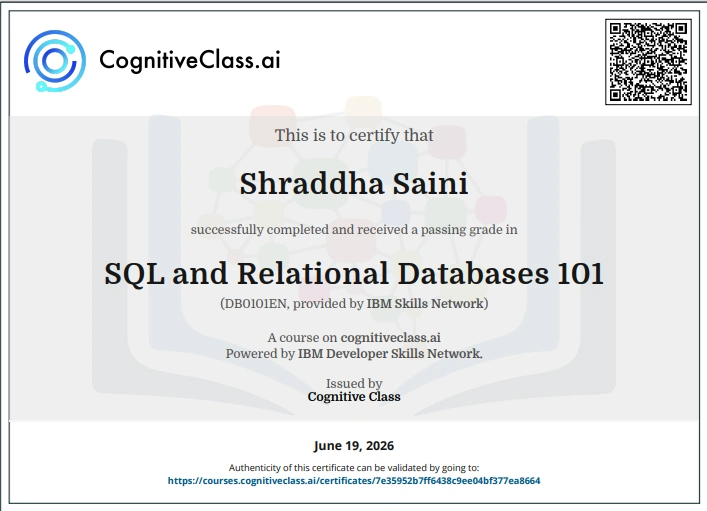
Successfully completing this course earns you a certificate. So let’s get started!
Course Syllabus:
Module 1 -SQL and Relational Databases 101
- Introduction to SQL and Relational Databases
- Information and Data Models
- Types of Relationships
- Mapping Entities to Tables
- Relational Model Concepts
Module 2 – Relational Model Constraints and Data Objects
- Relational Model Constraints Introduction
- Relational Model Constraints Advanced
Module 3 – Data Definition Language (DDL) and Data Manipulation Language (DML)
- CREATE TABLE statement
- INSERT statement
- SELECT statement
- UPDATE and DELETE statements
Module 4 – Advanced SQL
- String Patterns, Ranges, and Sets
- Sorting Result Sets
- Grouping Result Sets
Module 5 – Working with multiple tables
- Join Overview
- Inner Join
- Outer Join