
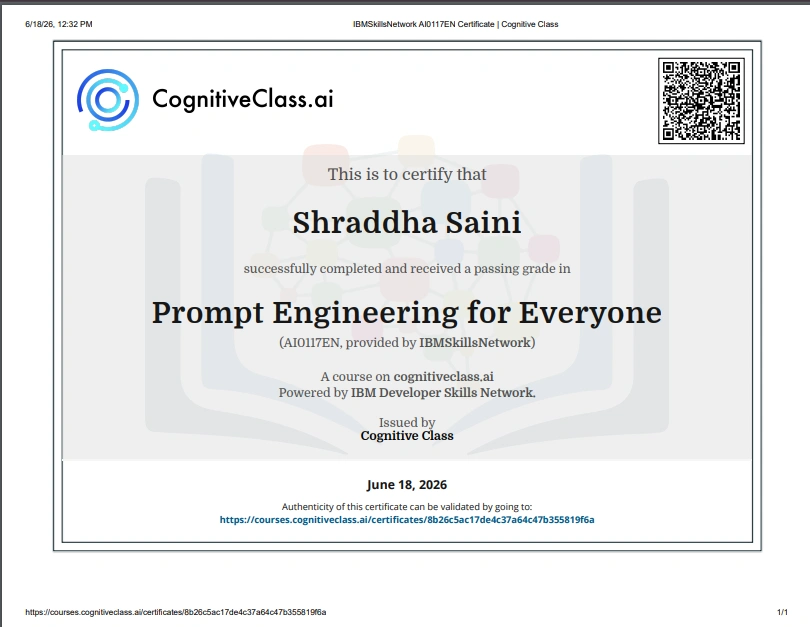
Organizer: IBMSkillsNetwork.
About the Course
- Free Online AI Prompt Engineering Course with Certificate.
- Certificate: Certificate Offered
- Estimated Effort: 5 Hours
- Level: Beginner
- Skills You Will Learn: Artificial Intelligence, Generative AI, LLM, Prompt Engineering
- Language: English
- Perfect For: Students, Freshers, Working Professionals, Career Switchers.
- 100% Free Learning Resources
- Industry-Recognized Digital Badges
- Self-Paced Learning
- Hands-On Projects & Assessments
- Resume & LinkedIn Profile Enhancement
Master the language of AI and unleash its full potential with our prompt engineering course. Gain the skills to craft compelling prompts that yield better, more accurate responses.
Learn how to create engaging prompts that generate better and more accurate responses. From understanding contextual cues to mitigating biases, we provide you with techniques to help you seamlessly interact with AI systems. Whether you’re a techie or a business professional, this course will revolutionize how you interact with AI.
Register now and become a compelling AI communicator in the digital age!
you’ll possess the expertise to leverage AI’s potential to its fullest, unlocking new realms of productivity and creativity. Start your journey toward mastering prompt engineering today!
Apply Link
100% Correct Answers AI Prompt Engineering Course Available Here
Prompt Engineering for Everyone Course Certification Answers Here-
Module 1: Introduction to Prompt Engineering Quiz Answers AI Prompt Engineering Course–
Question 1: Can computers inherently understand ambiguous instructions like humans do?
Yes
No
Ans. No
Question 2: Why do we historically use programming languages instead of plain English to instruct computers?
English is easier for computers to understand.
English is less ambiguous than programming languages.
Programming languages allow for faster execution of tasks.
English is more ambiguous than programming languages for providing specific instructions.
Ans. English is more ambiguous than programming languages for providing specific instructions.
Question 3: What does the term ‘zero-shot’ prompting mean in the context of Large Language Models (LLMs)?
The model is provided with multiple examples before making a prediction.
The model makes a prediction without any prior examples.
The model is trained with zero data.
The model takes zero seconds to produce an answer.
Ans. The model makes a prediction without any prior examples.
Question 4: Naive or standard prompts typical use few-shots prompting.
True
False
Ans. False
Question 5: Is the data that AI models like LLMs are trained on always flawless?
Yes, corportations spend billions ensuring such is the case.
No, despite best efforts, we can’t escape flawed and biased information.
Ans. No, despite best efforts, we can’t escape flawed and biased information.
Module 2: Getting Started with Prompt Engineering Quiz Answers AI Prompt Engineering–
Question 1: The Naive Approach to prompting the AI often results in overly generic and broad responses.
True
False
Ans. True
Question 2: Is the Persona Pattern used to make the AI adopt a specific character or identity for more customized results?
Yes
No
Ans. Yes
Question 3: Which of the following best describes the “Interview Pattern”?
The AI asking the user about its training data.
The AI interviewing the user to gather enough specific details for a customized answer.
The user providing the AI with all details at once, without the AI asking any questions.
Ans. The AI interviewing the user to gather enough specific details for a customized answer.
The AI asking random questions regardless of the topic.
Question 4: Why would one combine the Persona Pattern with the Interview Pattern?
To get more entertaining replies from the AI.
To make the AI’s responses impersonal.
To get both the viewpoint of an expert character and a detailed answer specific to us.
There’s no practical reason to combine them.
Ans. To get both the viewpoint of an expert character and a detailed answer specific to us.
Question 5: When requesting the AI to craft a blog post for the “Prompt Engineering for Everyone” course using the Interview Pattern, what did the AI first ask for?
The course’s price and duration.
Key information about the course, such as target audience and unique selling points.
The course’s difficulty level.
User reviews and feedback about the course.
Ans. Key information about the course, such as target audience and unique selling points.
Module 3: The Chain-of-Thought Approach Quiz Answers AI Prompt Engineering–
Question 1: What were the two phrases mentioned that can be added to the prompt to solicit better answers by doing step-by-step reasoning?
“Let’s solve it.” and “Break it down.”
“Let’s think step by step.” and “Let’s work this out in a step-by-step way to be sure we have the right answer.”
“Solve methodically.” and “Divide and conquer.”
“Think deeply.” and “Give a comprehensive answer.”
Ans. “Let’s think step by step.” and “Let’s work this out in a step-by-step way to be sure we have the right answer.”
Question 2: Using the Chain-of-Thought approach always requires retraining the AI model.
True
False
Ans. False
Question 3: Does using the Zero-Shot CoT prompting technique always produce short answers?
Yes
No
Ans. No.
Question 4: In the provided example about space exploration, why was the Chain-of-Thought approach used?
To get a quicker answer.
To focus only on the moon landing.
To get a more comprehensive and detailed answer by breaking down various facets of the topic.
To get a brief summary.
Ans.To get a more comprehensive and detailed answer by breaking down various facets of the topic.
Question 5: What is one downside to using the Chain-of-Thought approach as mentioned in the content?
It’s going It requires the AI to be retrained.
to make us an offer we can’t refuse.
It always provides a concise answer.
It may require knowledge of the subject or research, making it time-consuming.
Ans. It may require knowledge of the subject or research, making it time-consuming.
Module 4: Advanced Techniques Quiz Answers AI Prompt Engineering–
Question 1: According to researchers, the Tree-of-Thought (ToT) approach achieved a 74% success rate in the Game of 24, while Chain-of-Thought only achieved 4%.
True
False
Ans. True
Question 2: What does the Tree-of-Thought (ToT) prompting encourage the AI to do?
Follow a linear sequence of thoughts.
Build upon intermediate thoughts and explore branches.
Think really hard.
Follow a fixed set of instructions.
Question 3: Which of the following can be considered a benefit of the ToT approach?
Ans. Build upon intermediate thoughts and explore branches.
It always gives a concise answer.
It provides multiple viewpoints akin to brainstorming.
It focuses on a singular expert perspective.
Ans. It provides multiple viewpoints akin to brainstorming.
It reduces the depth of the answer to make it more generic.
Question 4: What purpose does controlling verbosity serve in the model’s response?
To increase the length of every answer.
To modify the depth of detail in the response.
To improve the accuracy of the answer.
To limit the model to short responses only.
Ans. To modify the depth of detail in the response.
Question 5: In the Nova System, who is responsible for ensuring the conversation remains on topic?
The Critical Evaluation Expert (CAE).
The Critical Execution Expert (CAE)
The User.
The Discussion Continuity Expert (DCE).
Ans. The Discussion Continuity Expert (DCE).
Master the language of AI and unleash its full potential with our prompt engineering course. Gain the skills to craft compelling prompts that yield better, more accurate responses.
Learn how to create engaging prompts that generate better and more accurate responses. From understanding contextual cues to mitigating biases, we provide you with techniques to help you seamlessly interact with AI systems.
Whether you’re a techie or a business professional, this course will revolutionize how you interact with AI. Register now and become a compelling AI communicator in the digital age!
you’ll possess the expertise to leverage AI’s potential to its fullest, unlocking new realms of productivity and creativity. Start your journey toward mastering prompt engineering today!
AI Prompt Engineering Course Syllabus:
Module 1: Introduction to Prompt Engineering
Lab 1: What is Prompt Engineering, and why do we care?
Lab 2: English as a new programming language
Quizzes
Module 2: Getting Started with Prompt Engineering
Lab 3: Getting to know our GPT-based AI tool
Lab 4: The Naive Prompting Approach and the Persona Pattern
Lab 5: The Interview Pattern
Quizzes
Module 3: The Chain-of-Thought Approach
Lab 6: The Chain-of-Thought Approach in Prompt Engineering
Quizzes
Module 4: Advanced Techniques
Lab 7: The Tree-of-Thought Approach in Prompt Engineering
Lab 8: Controlling Verbosity and the Nova System
Lab 9: Getting to Know watsonx Prompt Lab
Quizzes
Module 5: Final Project
Course Summary
Final Project (optional)