
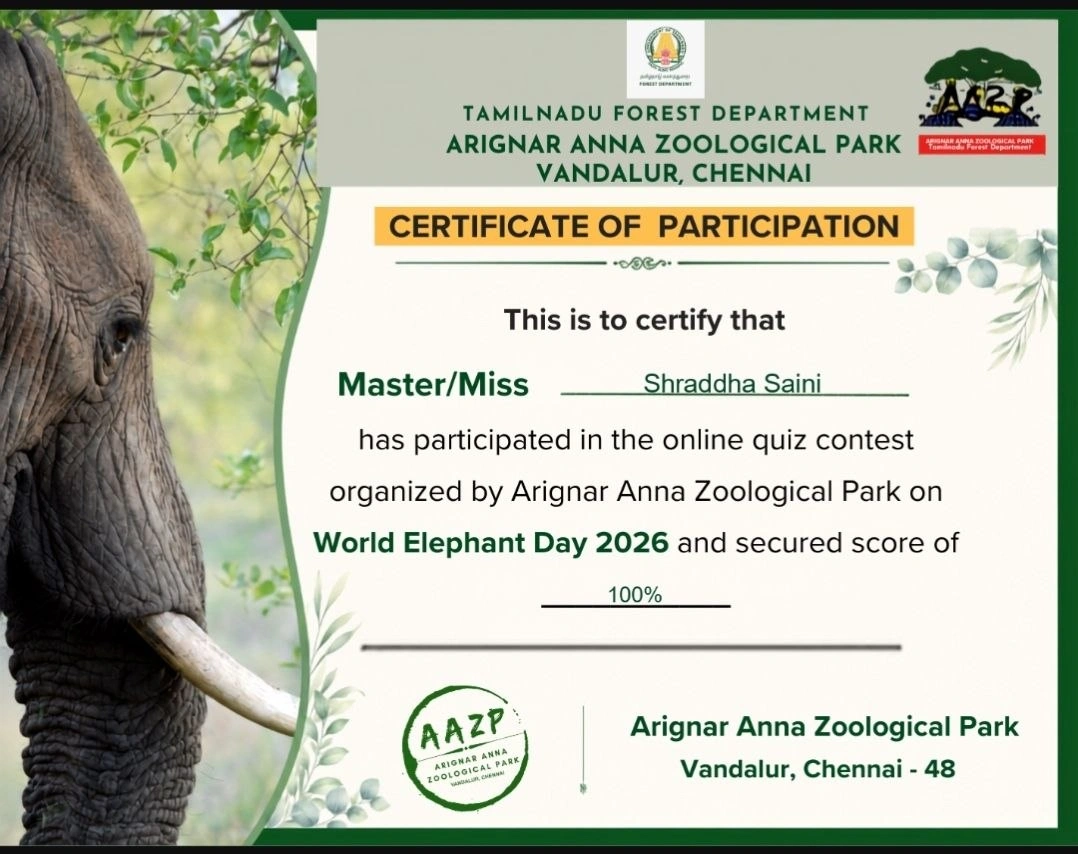
Organizer: TAMILNADU FOREST DEPARTMENT, ARIGNAR ANNA ZOOLOGICAL PARK VANDALUR, CHENNAIΙ.
About the Quiz Contest
- Online Quiz Contest on World Elephant Day 2026. How much do you really know about the world’s largest land animals?
- From their fascinating biology and unique behaviours to their incredible ways of living alongside humans there’s more to elephants than meets the eye. Challenge yourself. Discover something new. See how high you can score!
- Theme: Elephant Biology, Behaviour & Coexistence
- Date: 12 August 2026
- Open to Everyone
- Every successful participant will receive an e-Certificate with Score!
Apply Link
Learn. Challenge. Score. Celebrate Elephants!
100% Correct Answers Available Here
A Quiz on Elephant Biology, Behaviour & Coexistence
- What is the scientific name of the Indian elephant, a subspecies found widely in Tamil Nadu?
Loxodonta Africana
Elephas maximus indicus
Elephas maximus sumatranus
Loxodonta cyclotis
Ans. Elephas maximus indicus - Which part of an elephant’s body contains over 40,000 muscles and no bones, allowing it to perform tasks as delicate as picking a single leaf?
Ear
Tail
Trunk
Foot
Ans.
Ans. Trunk - Elephants exhibit a rare biological trait among mammals: they can detect ground vibrations through specialized receptors, primarily located in:
The eyes
Fatty pads and bone structures in their feet and trunk, sensitive to seismic vibrations
Their tusks
Their tail
Ans. Fatty pads and bone structures in their feet and trunk, sensitive to seismic vibrations - Which Tamil Nadu wildlife sanctuary/reserve is well known as part of the Nilgiri Biosphere Reserve and home to a large elephant population? Mudumalai Tiger Reserve
Anamalai Tiger Reserve
Srivilliputhur Megamalai Tiger Reserve
Kalakad Mundanthurai Tiger Reserve
Ans. Mudumalai Tiger Reserve - Elephants are described as a “keystone species.” What does this mean?
They are the fastest land mammal
Their presence and activities shape the entire ecosystem, benefiting many other species
They are the apex predators at the top of their food chain
They cannot survive outside protected forests
Ans. Their presence and activities shape the entire ecosystem, benefiting many other species - What is a group of female elephants and their young, led by the oldest and most experienced female, called?
A pod
A herd led by a matriarch
A pride
A colony
Ans. A pride - Which of these best describes the diet of an elephant?
Insectivorous, using their trunks to extract termites and ants from mounds
Herbivorous, eating grasses, bark, roots, and fruit
Omnivorous, including small animals
Feeds only on bamboo
Ans. Herbivorous, eating grasses, bark, roots, and fruit - On average, how many hours a day does a wild elephant spend feeding?
2-4 hours
6-8 hours
12-18 hours
20-22 hours
Ans. 12-18 hours - Elephant tusks are actually elongated:
Ear bones
Incisor teeth
Nose cartilage
Toenails
Ans. Incisor teeth - Which corridor in the Nilgiris-Eastern Ghats landscape is recognised as vital for elephant movement between Tamil Nadu, Kerala, and Karnataka?
Sigur Plateau corridor
Marina corridor
Pichavaram corridor
Kanyakumari corridor
Ans. Sigur Plateau corridor - What is the main reason elephants flap their large ears?
To communicate only
To regulate their body temperature by releasing heat
To scare away predators
To improve their eyesight
Ans. To regulate their body temperature by releasing heat - Elephants communicate over long distances using sounds humans usually cannot hear. What are these called?
Ultrasonic calls
Infrasonic (low-frequency) rumbles
Echo clicks
Sonar pulses
Ans. Infrasonic (low-frequency) rumbles - What is the term for the natural, periodic condition in male elephants marked by a surge in hormones and heightened aggression?
Molting
Musth
Rutting fever
Estrus
Ans. Musth - What is the average resting heart rate of an adult elephant, which is relatively slow due to its large body size?
25-35 beats per minute
60-70 beats per minute
100-120 beats per minute
150 beats per minute
Ans. 25-35 beats per minute - What is the best general approach recommended by wildlife experts for peaceful coexistence between people and elephants in shared landscapes?
Eliminating elephant habitats near farmland entirely
Combining scientific research, community awareness, protected corridors, and quick-response conflict mitigation teams
Ignoring elephant movement patterns
Keeping all elephants in captivity for safety
Ans. Combining scientific research, community awareness, protected corridors, and quick-response conflict mitigation teams - Why do elephant herds often follow traditional migratory routes passed down for generations?
They are guided by GPS-like instinct unrelated to memory
The matriarch remembers the location of water, food, and safe passages
They follow other animal species
It is random wandering
Ans. The matriarch remembers the location of water, food, and safe passages - Which of the following is a scientifically recommended way for farmers and communities to reduce human-elephant conflict?
Bursting firecrackers directly at elephants
Early-warning systems, community watch groups, and maintaining traditional elephant corridors
Clearing all forest buffer zones near farms
Feeding elephants directly to keep them near villages
Ans. Early-warning systems, community watch groups, and maintaining traditional elephant corridors - What is one key reason elephants are considered vital for forest regeneration?
They break open tough seed pods with their tusks so birds can plant them.
Seeds passed through their digestive system often germinate better and are spread across large distances
They carry seeds attached to their thick fur and hide across long distances
They build muddy mounds that act as natural green houses for seed
Ans. Seeds passed through their digestive system often germinate better and are spread across large distances - Elephants are considered “ecosystem engineers.” Which of these is an example of this role?
They pollinate flowers exclusively
They create clearings and waterholes, and disperse seeds over long distances through their dung
They burrow deep underground networks that aerate the forest soil.
They build permanent housing for other animal’s use
Ans. They create clearings and waterholes, and disperse seeds over long distances through their dung - What is the current IUCN Red List conservation status of the Asian elephant (Elephas maximus)?
Vulnerable
Endangered
Critically Endangered
Near Threatened
Ans. Endangered