
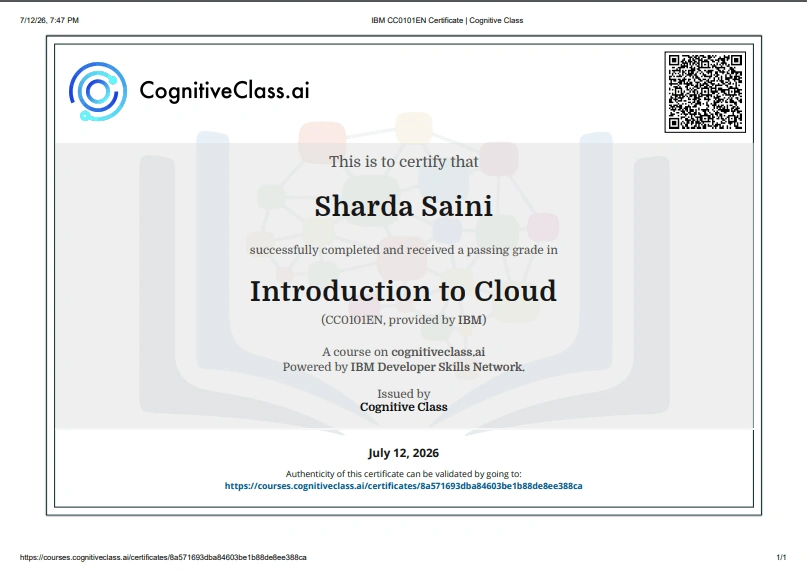
Organizer: IBM Developer Skills Network.
About the Course
- Topic: Course on Cloud Computing
- Certificate: Certificate Offered
- Estimated Effort: 6 Hours
- Level: Beginner
- Industries: Skills You Will Learn Cloud Computing
- Language: English
- Perfect For: Students, Freshers, Working Professionals, Career Switchers
- Free Online Learning
- Industry-Recognized Digital Credentials
- Self-Paced Courses
- Learn from IBM Experts
- Boost Your Resume & LinkedIn Profile.
Apply Link
100% Correct Answers Available Here
Course Name :- Introduction to Cloud Computing
Module 1. Overview of cloud computing
Question 1. In the US National Institute of Standards and Technology, NIST, definition of “cloud computing”, what does the statement “shared pool of configurable computing resources” include?
Data security, associated with loss or unavailability of data causing business disruption
Leverage cloud services over the open internet on hardware owned by the cloud provider
Networks, servers, storage, applications, and services
Five essential characteristics, three deployment models, three service models
Question 2. What tasks do hypervisors accomplish? Select two.
Note: Make sure you select all of the correct options!
Enable multiple operating systems to run alongside each other, sharing the same physical computing resources.
Facilitate access to mainframes for multiple users to access the same data storage layer.
Scale on demand to support fluctuating workloads.
Separates VMs logically and assigns each a share of the underlying computing power, memory, and storage.
Question 3. What are some of the cloud benefits that make it lower risk for enterprises to adopt cloud? Select two.
Note: Make sure you select all of the correct options!
Data security associated with loss or unavailability of data causing business disruption
The pay-as-you-go model allows enterprises to experiment with technologies as opposed to making long-term decisions based on little or no trial.
Diversity of standardization in how the constantly evolving technologies integrate and interoperate.
The speed with which applications can be up and running on the cloud versus months on traditional platforms, means enterprises can experiment, fail fast, learn, and course correct without setting them back significantly.
Module 2. Cloud Adoption And emerging technologies
Question 1.An IBM Institute for Business Value study says that more than three-quarters of enterprises today are using cloud computing to expand into new industries. What additional benefits do organizations find when adopting the cloud:
Avoid having to fail at all
Lengthen product lifecycles to ensure higher quality offerings
Continue making expensive decisions because it often worked in the past
Improve customer experience and create enhanced products and services
Question 2.What is the three-way symbiotic relationship between IoT, AI, and Cloud? MachineLearning & Artificial Intelligence
IoT delivers the data, AI powers the insights, and both emerging technologies leverage cloud’s scalability and processing power
Power, scale, dynamic nature, and economics of the cloud resources
AI consumes the data produced by IoT devices
Making sense of the endless streams of data from IoT devices
Question 3. What is the three-way relationship between blockchain, AI, and the Cloud?
Blockchain provides the trusted, decentralized source of truth, AI powers the analytics and decisions made from the collected data, and cloud provides the globally distributed, scalable, and cost-efficient computing resources to support both technologies.
Globally distributed, scalable, and cost-efficient computing resources.
An immutable network allowing members to view only those transactions that are relevant to them.
Lends trust and transparency to AI by recording the data and variables that go into a decision made in an AI algorithm.
Module 3. Cloud Computing Service and deployment modelds
Question 1.Which are some of the key components of cloud infrastructure? Select two.
Note: Make sure you select all of the correct options.
IaaS providers manage the hypervisors and provision virtual instances
IaaS providers deploy the middleware and install required applications on the virtual machines
IaaS providers manage large data centers that contain the physical machines required to power the various layers of abstraction on top of them
IaaS providers manage the hypervisors and end-users provision the virtual instances
Question 2. According to the video, which of these statements are true of Virtual Private Clouds (VPCs)? Select two.
Note: Make sure you select all of the correct options.
VPCs are provisioned in a logically isolated part of a shared public cloud
The VPC infrastructure is owned, managed, and operated by the public cloud service provider
VPCs may be provisioned over a cloud service provider’s infrastructure, but the infrastructure is owned, managed, and operated by the enterprise
VPC allows all users of the shared public cloud to access resources in the VPC on need basis; it also allows users of the VPC to access resources of the public cloud
Question 3. If an organization needs to run a highly sensitive and mission critical application with unpredictable performance and capacity requirements, which of the following models would best meet its requirements?
Private Cloud
Hybrid Cloud
On-premise Data Centers
Public Cloud
Module 4. Components of cloud Computing
Question 1. Is it possible to run completely different operating systems on Virtual Machines (VMs) that are on a single host? If yes, what makes this possible?
No, it is not possible—VMs are software-based versions of a single host. They cannot have different environments from one another.
No, it is not possible—A single host can only work as one single virtual environment, and can, therefore, have only one environment.
Yes, Containerization makes it possible—to have VMs that are unique physical entities, so you can have completely different Operating Systems on them.
Yes, Virtualization makes it possible— to have VMs, running different operating systems, on a single host.
Question 2. Which of these scenarios is ideal for the use of bare metal servers, as opposed to virtual servers? Select two.
Note: Make sure you select all of the correct options!
CPU and I/O intensive workloads
Low cost to use
Huge performance and strict security and compliance requirements
Workloads that require limited throughput and performance
Question3. Subnets are the main area where security is implemented in the cloud. What is used to provide security at the virtual instance level in subnets?
Virtual Private Cloud or VPC
Access Control Lists or ACLs
Load Balancers
Security Groups or SGs
Module 5. Cloud computing Storage and content delivery networks
Question 1. Which of these are features of Object Storage? Select two.
Note: Make sure you select all of the correct options!
Storage is attached to compute nodes using a fibre network
You can directly use Object Storage without attaching it to a compute node
Object Storage can be mounted on multiple compute nodes via an ethernet network
Object storage is effectively infinite
Question 2. There are four types of cloud storage available. Which storage type is ephemeral or non-persistent?
File storage
Direct Attached storage
Block storage
Object storage
Question 3. What is the main benefit of a Content Delivery Network (CDN)?
Speed, it makes your website faster by serving files from a location closer to the user.
Distribute tasks, workloads, and network traffic
Network topology
Enhanced control over network traffic by routing traffic to specified resources
Module 6. Emerging Trends, Cloud Native, DevOps and Application Moderation
Question 1. What are the key elements of a hybrid Multicloud strategy?
For seamless working, it is recommended that if you’re subscribed to the infrastructure services of a cloud provider, you should subscribe to the application services provided by the same vendor.
Embraces a mix of cloud models and services as long as they are from the same cloud service provider
Embraces a mix of cloud models while creating a vendor lock-in with the cloud provider
Connects an organization’s on-premise private cloud and third-party public cloud into a single infrastructure
Question 2. What is an attribute that distinguishes serverless computing from other compute models?
The serverless model requires NO provisioning of servers, installation of application stacks, or operation of the infrastructure BY the users/developers
Serverless computing does not require any underlying servers for executing workloads
End users pay for resources as long as they are running, even if idle
In the serverless computing environment, compute resources cannot be scaled up or down
Question 3. Cloud adoption is an integral part of application modernization. What are the other two important components of modernization?
VMs and Agile Methodology
Microservices and DevOps
Service Oriented Architecture and Waterfall Methodology
Serverless and Virtual Machines
Module 7. Cloud security, case studies and jobs in cloud computing
Question 1. What are some of the monitoring tools that help you to gain insights about your posture, compliance, and threats? Select two
Note: Make sure you select all of the correct options!
Security events
Hypervisors
Flow logs from the network
Data encryption
Question 2. What is the role SecDevOps plays in cloud security?
Security in the DevOps process helps embed security through the life cycle of an application
Helps maintain visibility of all data exchanges between public, private, and hybrid cloud environments
Provides policies, technological procedures, services, and solutions to secure the enterprise against security threats and breaches
Identity and Access Management
Question 3. The Weather Company migrated their weather web property to a secure, scalable, and global architecture in the IBM Cloud. What are some of the benefits they realized as a result of this migration? Select two.
Note: Make sure you select all of the correct options!
Optimize their systems for elasticity in handling extreme spikes in demand which can mean a difference between life and death for its users
Increase asset availability and overall equipment effectiveness
Harness local data centers to minimize latency for users spread across the globe
Faster development and release of new apps and digital self-service tools to customers
Introduction to Cloud Cognitive class Final Exam Answers:-
Question 1. Which cloud deployment model lets users use multiple cloud models working together seamlessly?
Broad Network Access
Private
Public
Hybrid
Note: Make sure you select all of the correct options!
Question 2. Which of these are essential characteristics of the Cloud? Select two.
Single-tenant
On-demand self-service
Resource pooling
Fixed fee
Note: Make sure you select all of the correct options!
Question 3. What are some cloud computing benefits? Select two.
Purchasing off-the-shelf software and upgrades
Diversity of standardization in how the constantly evolving technologies integrate and interoperate.
Competitive advantage
Flexibility and efficiency
Question 4. According to the International Data Corporation (IDC), what is that crucial ability that will make cloud computing essential for businesses to succeed, sustain, and compete in today’s markets? Computer Science
Multi-cloud infrastructures
Cognitively-enabled workflows
Applied exponential technologies such as AI, Automation, IoT, and Blockchain
Data-driven decisions
Note: Make sure you select all of the correct options!
Question 5. IoT, AI, Blockchain, and Analytics are emerging technologies enabled by the cloud. What are some of the attributes of cloud computing that enable these technologies? Select two.
Cloud resources are offered in a single-tenant model
The power and scale of cloud resources
Computing resources can be accessed via internet connection
Cloud offers on-demand computing
Question 6. In the car analogy used to explain the differences between the three cloud service models, which of the provided options is an analogy for PaaS?
Hiring a taxi
Leasing a car
Renting a car
Buying a car
Note: Make sure you select all of the correct options!
Question 7. Which of these scenarios are good use cases for Public Cloud? Select two.
Reducing time-to-market for products and services
Managing business critical platforms and applications
Disaster recovery, data protection, and business continuity
Applications with stable capacity and resourcing needs
Question 8. Private cloud platforms can be implemented internally or externally. What is an example of external private cloud platform?
Platform that is owned, managed, and operated by the organization
Virtual Private Cloud or VPC
Controlled access and customized security measures
Cloud platform that runs on-premises
Question 9. The infrastructure layer is the foundation of the cloud and consists of physical resources. Where do these physical resources reside?
Compute, Storage, and Networking Resources
Regions, Zones, and Data Centers
Virtual Servers, Bare Metal Servers, and Serverless computing resources
In a warehouse that houses a centralized mainframe server
Question 10. Why do bare metal servers take longer to provision than virtual servers?
They are physical servers that can be customized to specified capacity
Customer configures the physical servers
They’re multi-tenant servers, and all tenants must help configure them
GPUs for data analytics are hard to configure and provision
Question 11. Containers provide isolation of applications. What is one of the benefits this provides?
Open sourced runtime engine
Help keep malicious code in one container from impacting other containers
Abstraction from the host operating system
Repackaged into containers or containerized microservices
Question 12. What makes File storage an ideal solution for scenarios where common storage (a landing zone for incoming files) is needed?
Its consistently high speed
File storage can be mounted to multiple compute nodes at a time
File Storage is mounted to compute nodes via an ethernet network
Mounted from remote storage appliances
Question 13. Which of these scenarios are best suited for Block Storage? Select two.
Note: Make sure you select all of the correct options!
Workloads that need low-latency storage
Workloads that need disk sharing between compute nodes
Low cost is a consideration
Applications that need consistent fast access to disk, such as databases
Question 14. Which of the following is NOT a good fit for Object Storage?
Storage needs are finite and can be pre-defined
Data that does not require fast read and write speeds
Files or objects that are static
Operating systems or applications like databases
Question 15. What is a Content Delivery Network (CDN)?
A distributed server network
A network link
Network topology
A network node
Question 16. Note: Make sure you select all of the correct options!
What are some of the benefits of using microservices architecture? Select two.
Application components can be developed and updated independently of each other
Each microservice of an application needs to use the same stack and runtime environment
Components facing varied amounts of load can be scaled independently
Each line of code for a microservice needs to be written from scratch
Question 17. What are the characteristics of a cloud native application?
Collection of microservices that need to be scaled and updated in relation to each other
Collection of microservices with tightly coupled UI, business logic layer, and data layer
Collection of microservices that are built as one huge piece of software
Collection of microservices working together as a whole to comprise an application
Question 18. Note: Make sure you select all of the correct options!
DevOps’ tools, practices, and processes are helping tackle some of the complexities and challenges posed by the cloud. Identify two ways in which DevOps is mitigating these challenges. Select two.
DevOps processes outline the development principles that need to be followed to modernize monolithic applications to cloud native applications
By creating an automated deployment pipeline
By fully automating the infrastructure installation process in a way that is documented, repeatable, verifiable, and traceable
DevOps best practices eliminate the need to provision servers, build middleware, and install application code
Course syllabus
Module 1: Overview of Cloud Computing
- Definition and essential characteristics
- A brief history and evolution of Cloud
- Key cloud service providers and their services
Module 2: Cloud Adoption and Emerging Technologies
- Business case for Cloud Computing
- Emerging technologies supported by Cloud: AI, IoT, Blockchain, Analytics
Module 3: Cloud Computing Service and Deployment Models
- Service Models: IaaS, PaaS, SaaS
- Deployment Models: Public, Private, Hybrid
Module 4: Components of Cloud Computing
- Cloud Infrastructure Overview
- Virtualization, VMs, Bare Metal
- Secure Cloud Networks
- Containers
Module 5: Cloud Storage
- Direct Attached
- File Storage
- Block Storage
- Object Storage
- Content Delivery Networks (CDN)
Module 6: Cloud Native and Emergent Cloud Trends
- Hybrid Multicloud
- Serverless
- Microservices
- Cloud Native
- Application Modernization
General Information
- This course is self-paced.
- It can be taken at any time.
Recommended skills prior to taking the course
You don’t need to know anything about cloud to take this course, and no extensive programming experience is required.